Mention is no longer sold as a standalone product. Since July 1, 2026, existing customers can keep their plans, but new buyers are directed to Agorapulse Listening. The Mention features below describe the product available to existing customers. Source: Mention plans explained, checked October 8, 2026.
Brandwatch vs Mention is a choice between enterprise social intelligence and focused monitoring operations. Brandwatch is usually the better fit when research, insights, social intelligence, or a large social team owns the work. Mention is usually the better fit when the team wants a simpler monitoring, alerting, reporting, and competitor-tracking workflow without buying a full enterprise research suite.
The short version:
- Choose Brandwatch when you need consumer intelligence, historical research, audience analysis, custom dashboards, social media management, and analyst-owned reporting.
- Keep Mention if your existing plan meets your media monitoring, reporting, and collaboration needs.
- Choose Syften when fast alerts about web mentions and public conversations matter more than a listening dashboard.
This distinction matters because Mention has changed. It is no longer best understood as a lightweight self-serve social media tool with publishing attached. Its standalone plans stopped being sold on July 1, 2026. Existing customers keep access; new buyers are directed to Agorapulse Listening. Publish and Respond were also retired on January 30, 2026. That makes the comparison cleaner: Brandwatch is the heavier intelligence suite; Mention is the narrower monitoring and reporting product.
This guide compares Brandwatch and Mention first. Smaller teams that care about timely community alerts should also consider Syften.
Looking up Mention vs Brandwatch? The recommendation is the same: choose around the workflow someone will actually run every week.
For a wider shortlist, see our Mention alternatives guide.
Table of contents:
- Brandwatch vs Mention at a glance
- The real difference: consumer intelligence vs monitoring operations
- What the workflow looks like in practice
- Where Brandwatch fits best
- Where Mention fits best
- Where Syften fits best
- Data coverage, source limits, and alert quality
- Pricing and buying friction
- AI, reporting, and sentiment
- Common buying mistakes
- The fastest practical decision
- Brandwatch vs Mention: Which should you choose?
- Brandwatch vs Mention FAQ
Brandwatch vs Mention at a glance
- Brandwatch: consumer intelligence, social listening, market research, social media management, historical analysis, dashboards, and stakeholder reporting.
- Mention: media monitoring, social listening, alerts, sentiment, review monitoring, competitor tracking, reports, and collaboration.
- Syften: focused alerts from web mentions worth reviewing and reply-worthy public conversations, routed to Slack, email, RSS, API, Zapier, or webhooks.
Brandwatch is the higher-ceiling research suite. Mention is the more focused monitoring and reporting product. Syften is the narrow alert-and-reply workflow.
| Brandwatch | Mention | Syften | |
|---|---|---|---|
| Core focus | Consumer intelligence, audience research, social listening, and social workflows | Media monitoring, social listening, alerts, reports, and competitor tracking | Fast alerts from web mentions to review and public conversations your team can answer |
| Best workflow | Research question → dashboard → insight report | Keyword alert → monitoring feed → stakeholder report | Matched conversation → Slack/email/API alert → reply |
| Starting price | Quote required | No new standalone plans; existing contracts continue | $29.95/month |
| Publishing | Available through Brandwatch Social Media Management | Publish and Respond retired; Agorapulse recommended | Not a publishing tool |
| Best buyer | Insights, research, social intelligence, and larger social teams | Marketing, PR, brand, agency, and monitoring teams | Founders, marketers, support leads, and small B2B teams |
| Main risk | Buying a research suite without analyst ownership | Buying monitoring reports when nobody will maintain the feed | Too narrow if leadership needs dashboards and formal reporting |
The real difference: consumer intelligence vs monitoring operations
Brandwatch and Mention both monitor online conversations, but they are organized around different jobs.
Brandwatch Consumer Intelligence is built around research and analysis. Brandwatch says its dataset includes 1.7 trillion historical conversations back to 2010, 501 million new conversations added daily, official firehose access to Twitter, Tumblr, and Reddit, and conversations from 100 million unique sites. It helps teams understand audiences, categories, competitors, trends, and markets. Source: Brandwatch Consumer Intelligence, checked May 14, 2026.
Mention is built around monitoring operations. Its legacy Company plan covers social and review monitoring, web monitoring, Boolean search, sentiment, competitor benchmarking, custom reporting, collaboration, integrations, and support. Historical data and API access are paid add-ons. It fits existing customers who need alerts and reports more than a full research operating system. Source: Mention plans explained, checked October 8, 2026.
The practical difference is this: Brandwatch is easier to defend when the weekly work is "what does the market, audience, or category data tell us?" Mention is easier to defend when the weekly work is "what did people say about us, our competitors, and our campaigns, and who needs to know?"
What the workflow looks like in practice
The easiest way to choose is to picture the first month after buying the tool.
A Brandwatch workflow starts with a research question. An analyst or social intelligence owner builds queries around brands, competitors, audiences, campaigns, keywords, or market changes, then segments the results, reviews sentiment, checks historical movement, builds dashboards, and turns findings into reports or recommendations. Social Media Management can then carry those findings into publishing, engagement, benchmarking, and measurement.
A Mention workflow starts with alerts. A marketing, brand, or PR team creates keyword alerts, monitors owned social and review pages, reviews the feed, tags or assigns mentions, watches sentiment and spikes, and builds stakeholder or client reports. The job is less "run a research program" and more "keep a reliable monitoring system alive."
A Syften workflow starts with a conversation worth answering. A founder, marketer, or support lead tracks phrases like "alternative to [competitor]", "[category] recommendation", a product domain, or a problem keyword. When a match appears, it lands in Slack, email, RSS, API, Zapier, or a webhook with a direct link to the thread.

Syften is built around the moment after a relevant match appears: should someone reply now?
A consumer insight report points to Brandwatch. A monitoring feed, alert, or client-ready mention report points to Mention. An "open this thread and reply today" workflow points to Syften.
Where Brandwatch fits best
Brandwatch fits best when the work is consumer intelligence, social research, and social data storytelling.
Brandwatch's strongest case is data depth plus analysis. Its Consumer Intelligence page emphasizes historical and real-time social data, AI-assisted exploration, image analysis, auto segmentation, 50+ live visualizations, data uploads, exports to Excel/PPT/PDF, API access, automated alerts, and Vizia reporting. Source: Brandwatch Consumer Intelligence, checked May 14, 2026.
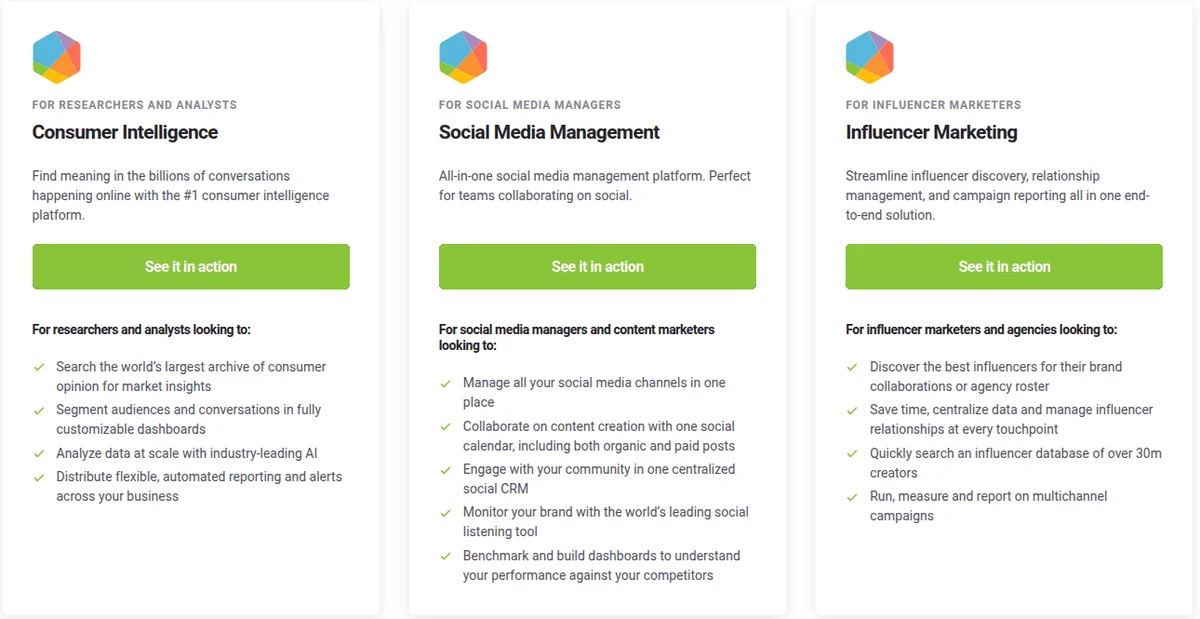
Brandwatch packages the buying path around solution categories and demo-style CTAs, not a simple self-serve price list.
That makes Brandwatch useful when someone needs to answer questions that basic alerts cannot handle: which audience segment is driving a complaint, what themes explain a campaign spike, how sentiment differs by topic, which competitor is gaining share of conversation, or how a category narrative has changed over time.
Brandwatch also has a broader suite. Its public suite page lists Consumer Intelligence, Search Intelligence, Media Intelligence & Insights, Social Media Management, and Influencer Marketing. That matters when listening needs to connect to publishing, engagement, influencer work, benchmarks, and executive reporting.
The tradeoff is operational weight. Brandwatch works best when someone owns query quality, dashboards, segmentation, exclusions, interpretation, and stakeholder reporting. Without that owner, the product can become a powerful place to store data that nobody turns into decisions.
Where Mention fits best
Mention fits best when the team wants a structured monitoring and reporting workflow without the full research surface of Brandwatch.
Mention's help center describes Alerts as the foundation of the product. Alerts gather new online content through keyword monitoring and monitored pages or reviews. Mention says Basic Alerts can monitor X/Twitter, forums, Reddit, blogs, videos, news, and web sources, while Advanced Alerts support more precise Boolean work and historical data access. Source: Mention Alerts explained, checked May 14, 2026.
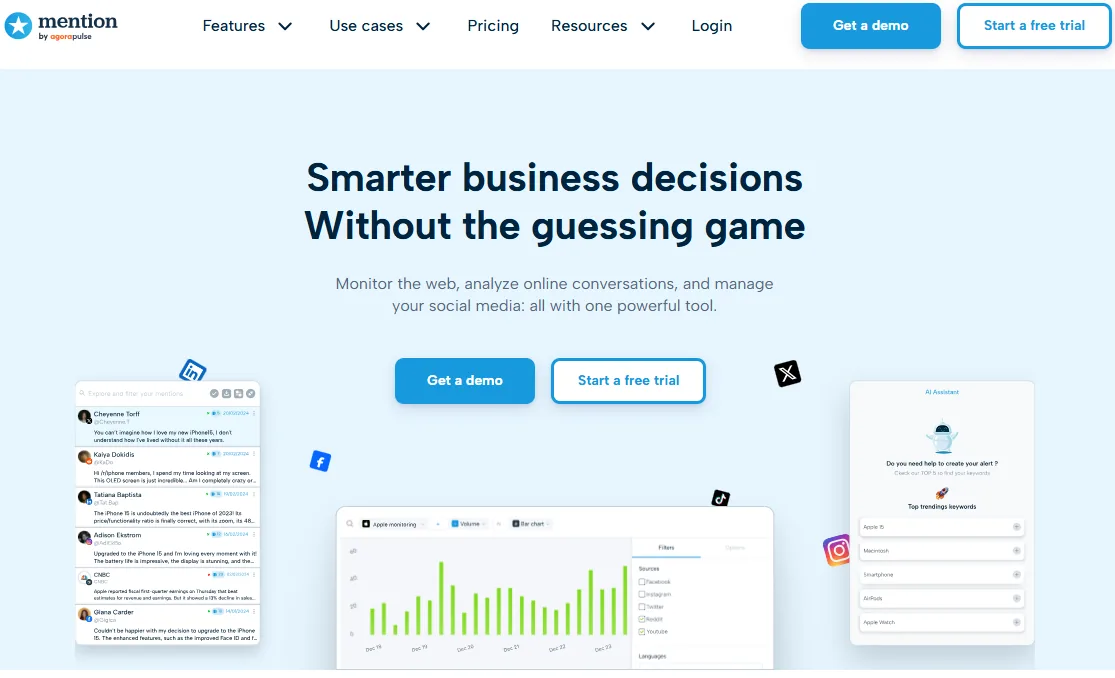
Mention is easier to evaluate as a monitoring, alerting, and reporting product than as a full social management suite.
Mention also has useful source details that buyers should check before signing. Its source documentation says it can keyword crawl Twitter/X, public discussion sites, Reddit, blogs, videos, news, web, and YouTube. It can also monitor specific Facebook, Instagram, X/Twitter, and review pages. The same documentation lists limits: Mention fetches new data after alert creation on many sources, cannot crawl private subreddits, cannot monitor specific subreddits in alerts, does not fetch Instagram comments, and cannot monitor comments on news sites. Source: Mention Sources explained, checked May 14, 2026.
The biggest product shift is publishing. Mention says Publish and Respond were retired on January 30, 2026, and recommends Agorapulse as the social publishing and engagement path. That makes Mention a cleaner listening choice, but a weaker all-in-one social media management choice. Source: Mention publishing update, checked May 14, 2026.
The tradeoff is ceiling. Mention is more focused than Brandwatch, which can be a strength. But if you need deep historical research, audience segmentation, image analysis, large stakeholder dashboards, or social management inside the same suite, Brandwatch is the more natural fit.
Where Syften fits best
Syften fits a different use case: finding conversations worth joining.
A small B2B team might track competitor names, product domains, category terms, founder names, subreddits, forums, GitHub issue comments, and buying-intent phrases. A good match goes straight to the person who can reply, support the user, learn from the complaint, or start a sales conversation.
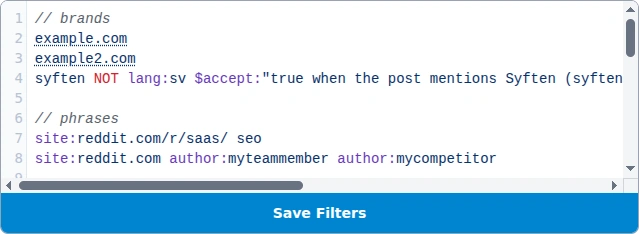
Precise filters matter more than broad source counts when the goal is to receive only alerts someone can act on.
This does not replace Brandwatch's consumer intelligence or Mention's reporting workflow. Syften is intentionally narrower. It is useful when Reddit, Hacker News, GitHub, forums, Slack communities, YouTube, blogs, podcasts, and X/Twitter are where prospects and users talk.
The limitation is reporting depth. Syften will not give you a consumer research archive, social publishing calendar, formal monitoring report builder, or enterprise visualization layer. It gives you filtered alerts fast enough to join the conversation.
Data coverage, source limits, and alert quality
Source lists matter, but they are not the whole decision. The real question is whether the product can turn its data into a workflow your team trusts.
- Historical research: Brandwatch is stronger when you need historical conversations back to 2010. Mention can support historical access in monitoring workflows, but it is more alert-led.
- Reddit: Brandwatch is the stronger enterprise research fit. Mention can fetch public Reddit posts and comments when keywords match, but its source documentation says specific subreddit targeting is not available inside alerts.
- Publishing and engagement: Brandwatch has Social Media Management. Mention retired Publish and Respond and points users to Agorapulse for that job.
- Stakeholder reporting: Brandwatch is better for complex dashboards and research narratives. Mention is better for monitoring reports, sentiment, share of voice, and competitor tracking.
Before choosing, test your own terms. Use brand names, competitors, product domains, subreddit-style phrases, campaign names, misspellings, executive names, and negative issue terms. Check not only whether results appear, but whether the team can understand and act on them without creating a second job.
Pricing and buying friction
Pricing tells you what kind of buying motion each product expects.
Brandwatch is demo-led. Its public pages group the product into Consumer Intelligence, Social Media Management, Influencer Marketing, Search Intelligence, and related services, but they do not publish a simple self-serve starting price. That is normal for enterprise social intelligence, but it means budget comparison requires a sales process.
Mention no longer sells standalone plans. Existing customers should compare their contract price and limits with a Brandwatch quote. For new purchases, Agorapulse Listening is available through sales as a standalone package or an add-on to Advanced or Tailored Agorapulse plans. Source: Mention plans explained, checked October 8, 2026.
Syften publishes monthly pricing: Entry costs $29.95/month, Standard costs $49.95/month, and Pro costs $119.95/month. Standard and Pro include AI filtering, with Pro adding more matches, full archive history, archive API search, MCP, and webhooks. Twitter and YouTube monitoring are optional paid add-ons on Standard and Pro.
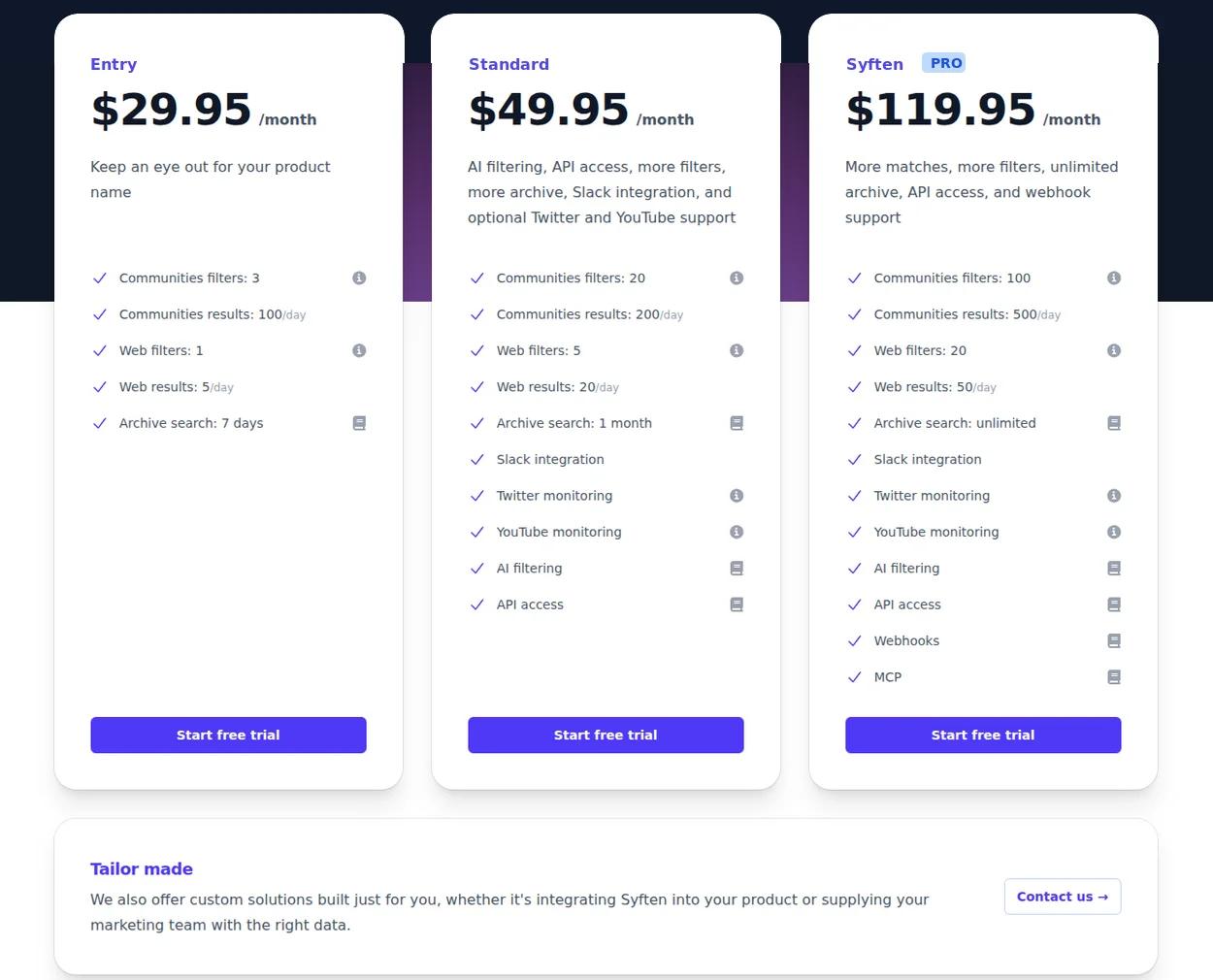
Syften's price reflects the narrower job: useful alerts rather than an enterprise intelligence suite.
This does not make Syften "cheaper Brandwatch" or "cheaper Mention." It makes Syften easier to buy when the actual job is narrower than a monitoring platform: catch relevant web mentions and public conversations and act quickly.
AI, reporting, and sentiment
AI helps both Brandwatch and Mention, but it reduces different kinds of work.
Brandwatch AI is built around analysis and social workflows. Brandwatch describes Iris as an AI assistant for turning data into human-readable insights, with AI-powered search, image analysis, auto segmentation, writing assistance, conversation insights, content insights, post analysis, and influencer summaries across parts of the suite.
Mention AI and analytics are closer to monitoring workflows. Mention's current plan emphasizes sentiment analysis, trend identification, competitor benchmarking, share of voice, influence scoring, audience insights, custom reports, dashboards, and notifications. Its feed also supports summarizing and organizing mentions.
Syften AI is narrower. The main workflow is still search, filters, and links to matching conversations. AI filtering helps decide whether a keyword match should trigger a notification.
Use sentiment carefully in all monitoring tools. Sentiment is useful for spotting places to investigate, but it can be misleading when one post mentions a company, competitor, category, and complaint in the same sentence. The buyer should ask what entity sentiment attaches to, how sarcasm and mixed posts are handled, and how easy it is to audit examples behind a chart. We explain the issue in our sentiment analysis guide.
Common buying mistakes
Mistake 1: buying Brandwatch when nobody owns research. Brandwatch is strongest when someone will build queries, maintain dashboards, interpret patterns, and turn social data into decisions. Without that owner, the extra depth can go unused.
Mistake 2: buying Mention for social media management. Mention is now clearer as a listening and monitoring product. If publishing, inbox management, approvals, and engagement are central, evaluate Agorapulse, Brandwatch Social Media Management, Hootsuite, Sprout Social, or another social suite.
Mistake 3: comparing source counts without checking source limits. A source logo does not tell you whether comments, private communities, historical data, specific pages, or specific subreddits are available. Test the exact sources that matter.
Mistake 4: choosing Syften when the brief is really reporting. Syften is intentionally narrow. If leadership needs dashboards, share-of-voice reporting, historical consumer research, or client-ready monitoring reports, Brandwatch or Mention is the better class of product.
The fastest practical decision
Use the weekly work as the tie-breaker.
- Choose Brandwatch when an insights, research, or social intelligence team studies audiences, competitors, trends, sentiment, and historical conversation data.
- Keep Mention if your team already uses its monitoring, alerts, and reports for PR or brand work.
- Choose Syften when a founder or small B2B team wants to know when someone asks for an alternative, complains about a competitor, or mentions a category problem.
This is also the easiest way to avoid overbuying. When nobody will maintain research dashboards, do not buy an enterprise intelligence suite. When nobody will use monitoring reports, do not buy a monitoring platform. When nobody will reply to alerts, do not buy Syften either.
Brandwatch vs Mention: Which should you choose?
Choose Brandwatch when:
- Insights, research, social intelligence, or a larger social team owns the problem.
- You need historical social data, audience analysis, custom dashboards, image analysis, and executive reporting.
- The output is an insight report, market read, campaign analysis, benchmark, or strategic recommendation.
- You want listening connected to Brandwatch Social Media Management, Influencer Marketing, or broader suite workflows.
- You have budget and team capacity for a demo-led enterprise setup.
Explore Brandwatch Consumer Intelligence
Keep Mention when:
- You need a monitoring feed, alerts, sentiment, share of voice, competitor tracking, and reports.
- Your team wants a more focused listening product than Brandwatch.
- Social and review monitoring, web monitoring, Boolean alerts, Slack/Zapier integrations, and custom reports cover the job.
- You do not need publishing and responding inside Mention itself.
- Your existing Mention plan fits the budget and monitoring needs.
For new purchases, request an Agorapulse Listening quote.
Choose Syften when:
- You want alerts about specific conversations your team can answer quickly.
- The public web, Reddit, Hacker News, GitHub, forums, Slack communities, YouTube, or X/Twitter matter to your market.
- You track competitor alternatives, product complaints, support issues, domains, authors, and buying-intent phrases.
- You want matches delivered to Slack, email, RSS, API, Zapier, or webhooks.
- You would rather pay for precise alerts than buy a monitoring or research platform.
The cleanest decision is not "which product has more features?" It is "which product matches the work we will do every week?"
Pick Brandwatch when the week is mostly research, social intelligence, audience analysis, dashboards, and insight reporting. Pick Mention when the week is mostly monitoring, alerts, sentiment, reviews, competitor reports, and stakeholder updates. Pick Syften when the week is mostly finding specific web mentions and public conversations and acting on them while they are still active.
Related comparisons: Brand24 vs Mention, Hootsuite vs Mention, Talkwalker vs Brandwatch, and Brandwatch vs Meltwater.
Brandwatch vs Mention FAQ
Is Brandwatch better than Mention?
Brandwatch is better when the main job is consumer intelligence, social research, audience analysis, historical data, dashboards, and social suite workflows. Mention is better when the main job is focused monitoring, alerts, sentiment, reviews, competitor tracking, and reporting.
Is Mention cheaper than Brandwatch?
Mention no longer sells standalone subscriptions. Existing customers can compare their contract with a Brandwatch quote. New buyers should request quotes for Brandwatch and Agorapulse Listening instead of treating the old Mention Company price as a current offer.
Does Mention still offer social publishing?
Mention no longer offers social publishing in the same product. Mention says Publish and Respond were retired on January 30, 2026, and recommends Agorapulse for publishing and engagement. Mention's strongest current fit is listening, monitoring, alerts, analytics, and reports.
Which is better for Reddit monitoring?
Brandwatch is the stronger enterprise research choice and positions Reddit as part of its official data coverage. Mention can fetch public Reddit posts and comments when keywords match, but its source documentation says you cannot monitor specific subreddits in alerts. Syften is the more focused fit when Reddit monitoring is about catching specific threads to answer.
Which is better for agencies?
Brandwatch is better for agencies that need deep research, dashboards, social intelligence, and larger social workflows. Mention is better for agencies that mostly need monitoring, alerts, custom reports, competitor tracking, review monitoring, and client-ready updates without the full Brandwatch research layer.
What is the best alternative to Brandwatch or Mention?
To compare another enterprise intelligence suite, look at Talkwalker, Meltwater, Sprinklr, or Cision. To compare another monitoring dashboard, look at Brand24, Awario, or Mentionlytics. When the need is fast alerts from public communities and web conversations your team can answer, Syften is the more focused alternative.
If Reddit is the specific channel you care about, compare dedicated options in our guide to the best Reddit monitoring tools before buying a broad listening suite.
This comparison was fact-checked and refreshed in May 2026 against current pricing and product pages. Pricing, feature packaging, and enterprise contract terms can change, so verify current details with each platform before buying.