Hootsuite vs Brandwatch is really a workflow decision. Hootsuite is usually the better fit when the main job is running owned social channels: publishing, scheduling, inbox work, approvals, analytics, and Enterprise listening powered by Talkwalker. Brandwatch is usually the better fit when the main job is social intelligence: consumer research, listening, audience analysis, benchmarking, dashboards, and social media management in one suite.
The short version:
- Choose Hootsuite when your team needs a social media management workspace first, with listening attached to publishing, engagement, analytics, and customer-care workflows.
- Choose Brandwatch when your team needs deeper social listening, consumer intelligence, audience research, and analyst-owned reporting, with social management available in the same ecosystem.
- Choose Syften when you do not need a full social suite and mainly want fast alerts for specific web mentions to review and public conversations you can answer.
That distinction matters because the search result is noisy. Hootsuite's own comparison page frames Hootsuite Enterprise as the stronger choice over Brandwatch. Review sites compare feature checklists. None of that answers the operational question: are you buying a social media operating layer, a research and listening suite, or a focused alerting tool?
This guide starts with the Hootsuite vs Brandwatch decision, then explains where Syften is the better alternative for smaller teams that care about timely community alerts.
Table of contents:
- Hootsuite vs Brandwatch at a glance
- The real difference: social operations vs social intelligence
- What the workflow looks like in practice
- Where Hootsuite fits best
- Where Brandwatch fits best
- Where Syften fits best
- Social listening depth
- Publishing, engagement, and team workflows
- Pricing and contract friction
- Common buying mistakes
- The fastest practical decision
- Hootsuite vs Brandwatch: Which should you choose?
- Hootsuite vs Brandwatch FAQ
Hootsuite vs Brandwatch at a glance
| Hootsuite | Brandwatch | Syften | |
|---|---|---|---|
| Core focus | Social media management, publishing, inboxes, analytics, and Enterprise listening | Consumer intelligence, social listening, social media management, and reporting | Focused alerts from high-signal web mentions and public conversations |
| Best owner | Social media, content, customer care, and social operations teams | Insights, research, social intelligence, brand, and larger social teams | Founders, marketers, support leads, and small B2B teams |
| Publishing | Strong: calendar, scheduling, AI content help, approvals, asset workflows, and bulk publishing | Strong in Social Media Management: Publish, Engage, Measure, Benchmark, Listen, and Influence | No publishing suite |
| Listening | Lightweight mention search on self-serve plans; deeper Listening powered by Talkwalker on Enterprise | Core strength: Consumer Intelligence, social listening, audience research, dashboards, and alerts | Keyword alerts routed to Slack, email, RSS, API, Zapier, or webhooks |
| Data scale claims | Hootsuite's comparison page cites 150M+ websites, 30+ social networks, and 187 languages for listening | Brandwatch help says it processes half a billion posts from 100M+ sources daily | Focused source coverage for communities, developer channels, forums, and social platforms |
| Starting price | Public Standard and Advanced tiers; Enterprise is custom | Quote required for main plans | $29.95/month |
| Trial / purchase path | 30-day trial on self-serve tiers; Enterprise is sales-led | Demo-led, quote-based buying path | Self-serve 14-day trial |
| Main risk | Buying a publishing suite when you only need monitoring alerts | Buying a research suite without analyst ownership | Too narrow if you need publishing, consumer research, or enterprise reporting |
The real difference: social operations vs social intelligence
Hootsuite and Brandwatch overlap because both can help teams publish, listen, engage, analyze, and report. The difference is where each product feels most natural.
Hootsuite's plan page starts with social media management: social accounts, scheduling, AI content help, one inbox, analytics, competitor benchmarks, reports, and Enterprise add-ons. Listening is part of that operating layer, especially for Enterprise buyers using Hootsuite Listening powered by Talkwalker.
Brandwatch's plan page splits the buyer by workflow: Consumer Intelligence for researchers and analysts, Social Media Management for social media managers and content marketers, and Influencer Marketing for influencer teams. That positioning is broader than a publishing calendar. It is a social intelligence suite with management modules attached.
The practical difference is this: Hootsuite is easiest to justify when the team already manages owned social channels every day. Brandwatch is easiest to justify when the team needs to understand conversations, audiences, competitors, and trends at a deeper level.
What the workflow looks like in practice
The fastest way to choose is to picture the first month after buying the tool.
A Hootsuite workflow starts with the calendar. A social team plans posts, writes variants with AI help, schedules across networks, manages replies in a shared inbox, benchmarks competitors, exports reports, and uses mention search or Enterprise listening to inform the next content and response decisions.
A Brandwatch workflow starts with a question. An analyst or social intelligence owner builds a query around a brand, competitor, audience, campaign, or market, cleans the results, segments the conversation, checks patterns over time, and turns the findings into a dashboard, report, or strategic recommendation. Social Media Management can then carry those insights into publishing and engagement work.
A Syften workflow starts with a thread worth answering. A founder, marketer, or support lead tracks phrases like "alternative to [competitor]", "[category] recommendation", a product domain, or a problem keyword. When a match appears, it lands in Slack, email, RSS, API, Zapier, or a webhook with a direct link to the conversation.

Syften is built for the moment after a match appears: deciding whether the conversation is worth a reply.
If the output you want is a social calendar, Hootsuite is closer. If the output you want is an insight report, Brandwatch is closer. If the output you want is a useful conversation, Syften is closer.
Where Hootsuite fits best
Hootsuite fits best when social media is an owned channel with recurring work. It is strongest for teams that publish often, manage multiple social profiles, respond from a shared inbox, use reports to improve content, and want one workspace for social operations.
The self-serve plans show this clearly. Standard includes up to 10 social accounts, unlimited post scheduling, best-time-to-post recommendations, AI image and caption help, Canva and Adobe Express templates, one inbox, DM automations, 7-day mention search, sentiment, and competitor benchmarking. Advanced adds unlimited social accounts, report templates, saved replies, bulk scheduling, auto-routing and tagging, 20 competitor benchmarks, report exports, and 30-day mention search.
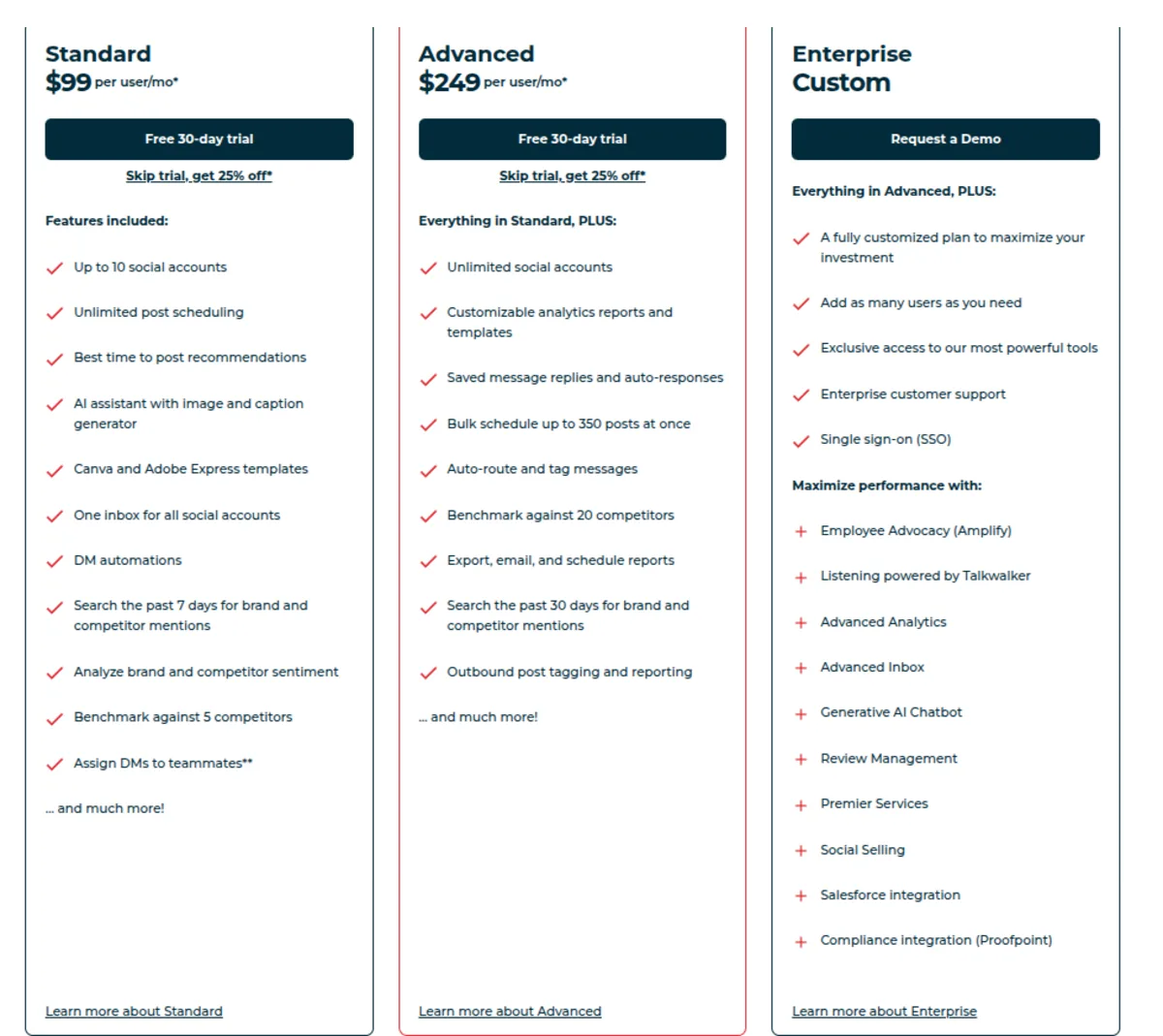
Hootsuite packages publishing, inboxes, analytics, benchmarking, and listening by tier.
Enterprise is where Hootsuite becomes a more serious listening choice. Hootsuite lists Listening powered by Talkwalker, advanced analytics, advanced inbox, review management, Premier Services, Salesforce integration, Proofpoint compliance integration, and other enterprise tools.
Hootsuite is weaker when publishing is not the job. If your team does not need a social calendar, shared inbox, approvals, analytics, or channel operations, Hootsuite can become a large interface around a smaller monitoring problem.
Where Brandwatch fits best
Brandwatch fits best when the work is social intelligence and research. It is the more natural choice when the buyer cares about audience segmentation, historical conversation analysis, competitor research, sentiment, trend discovery, and reporting across a large dataset. That is also where sentiment analysis needs the most skepticism: the bigger the dataset, the easier it is for a clean chart to hide messy individual examples.
Brandwatch's Consumer Intelligence help center says the product processes half a billion posts from more than 100 million sources every day, with coverage across social media, news, uploaded data, and more. The same ecosystem includes Social Media Management for teams that also need publishing, engagement, measurement, benchmarking, and listening.
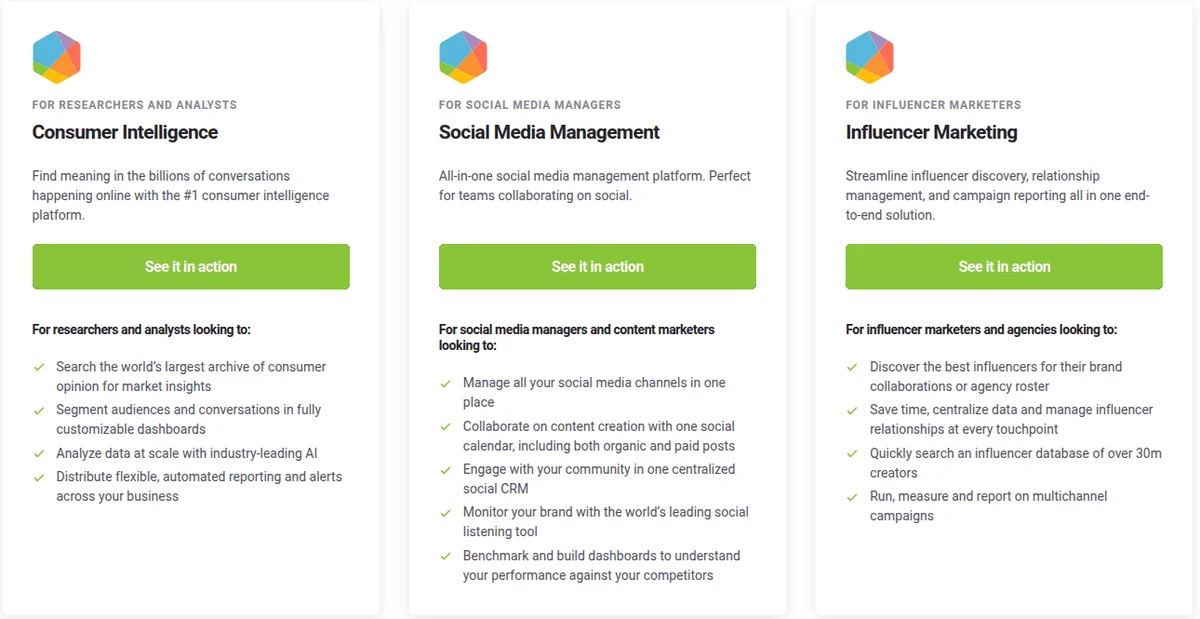
Brandwatch separates the buying decision by workflow: research, social management, or influencer marketing.
Brandwatch is especially strong when someone owns the research process. Query quality, exclusions, saved dashboards, topic modeling, sentiment review, and stakeholder reporting all need discipline. The platform can answer deeper questions than a basic scheduler, but only if the team has time to ask better questions and maintain the dashboards behind them.
Brandwatch is weaker when the buyer wants a quick answer to a narrow alerting problem. If nobody is going to maintain the queries, review dashboards, or turn social data into decisions, the extra intelligence layer can become an expensive place to store unused data.
Where Syften fits best
Syften fits best when the useful output is a timely alert, not a managed social workflow or consumer research project.
A small B2B team might track competitor names, domains, product categories, founder names, subreddits, forum topics, GitHub issue comments, and buying-intent phrases. A good match goes straight to the person who can reply, support the user, learn from the complaint, or start a sales conversation.
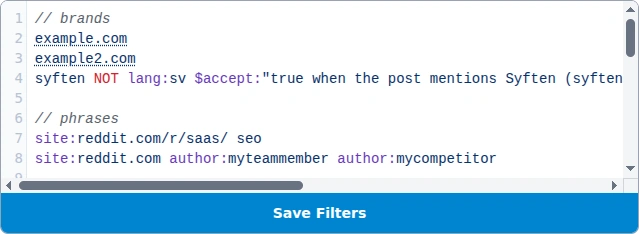
Precise filters matter more than source count when the goal is to receive only alerts someone can act on.
This is not a replacement for Hootsuite's publishing workflows or Brandwatch's consumer intelligence. Syften is intentionally narrower. It is useful when public web mentions matter and Reddit, Hacker News, GitHub, forums, Slack communities, YouTube, X/Twitter, Bluesky, Mastodon, and similar sources are where people ask questions your team can answer.
The tradeoff is reporting depth. Syften will not give you a polished enterprise social suite, a consumer intelligence archive, or a broad visual monitoring workflow. It gives you filtered alerts fast enough to join the conversation.
Social listening depth
Hootsuite's listening story depends heavily on plan. Standard and Advanced include mention search windows that support the social workflow. Enterprise adds Hootsuite Listening powered by Talkwalker, which Hootsuite says can monitor across Instagram, Facebook, X, Threads, LinkedIn, Reddit, Bluesky, YouTube, Quora, podcasts, news sites, forums, and more.
Hootsuite's own comparison page makes a similar coverage claim for Hootsuite Enterprise: 150M+ websites, 30+ social networks, and 187 languages. Because it is a vendor comparison, use it as positioning rather than neutral analysis. The useful takeaway is still clear: Hootsuite's deepest listening capability lives in the Enterprise path and is tied to Talkwalker.
Brandwatch is more naturally a listening and research platform. Consumer Intelligence is built around searching, analyzing, segmenting, and reporting on conversations. Its Social Media Management suite also includes Listen, Measure, Benchmark, Engage, and Publish, so teams can connect insight work to social operations.
Syften's listening depth is narrower but more operational. It is not trying to summarize a market. It is trying to tell you when a specific public conversation deserves attention.
Publishing, engagement, and team workflows
Hootsuite is usually the simpler answer for publishing-heavy social teams. Its product is organized around posts, calendars, accounts, inboxes, analytics, approvals, reports, and social performance.
Brandwatch's Social Media Management suite can also handle the social operations layer. Its plans page describes a single social calendar for organic and paid posts, a centralized social CRM, brand monitoring, benchmarking, and dashboards. Its Engage product centralizes messages in one inbox, supports custom feeds and automations, and includes Iris AI reply help, templates, sentiment, labels, team collaboration, team reports, Salesforce routing, and case management.
The difference is how teams tend to buy and use them. Hootsuite feels like a social media management tool that grows into Enterprise listening. Brandwatch feels like an intelligence suite that also offers social management. If the same team owns both social execution and social research, either can make sense. If one job clearly dominates, choose around that job.
Pricing and contract friction
Pricing tells you what kind of buyer each product expects.
Hootsuite has public Standard and Advanced tiers with 30-day trials, plus custom Enterprise pricing. That makes it easier to test if you mainly need social management. The catch is that the most serious listening features sit behind the Enterprise path.
Brandwatch is quote-led for the main products. Its plan page routes buyers toward Consumer Intelligence, Social Media Management, or Influencer Marketing demos instead of publishing a simple self-serve price list. That makes sense for enterprise buyers, but it adds friction if the use case is small.
Syften publishes its prices: $29.95/month for Entry, $49.95/month for Standard, and $119.95/month for Pro. A lean team can test alert quality without a procurement process.
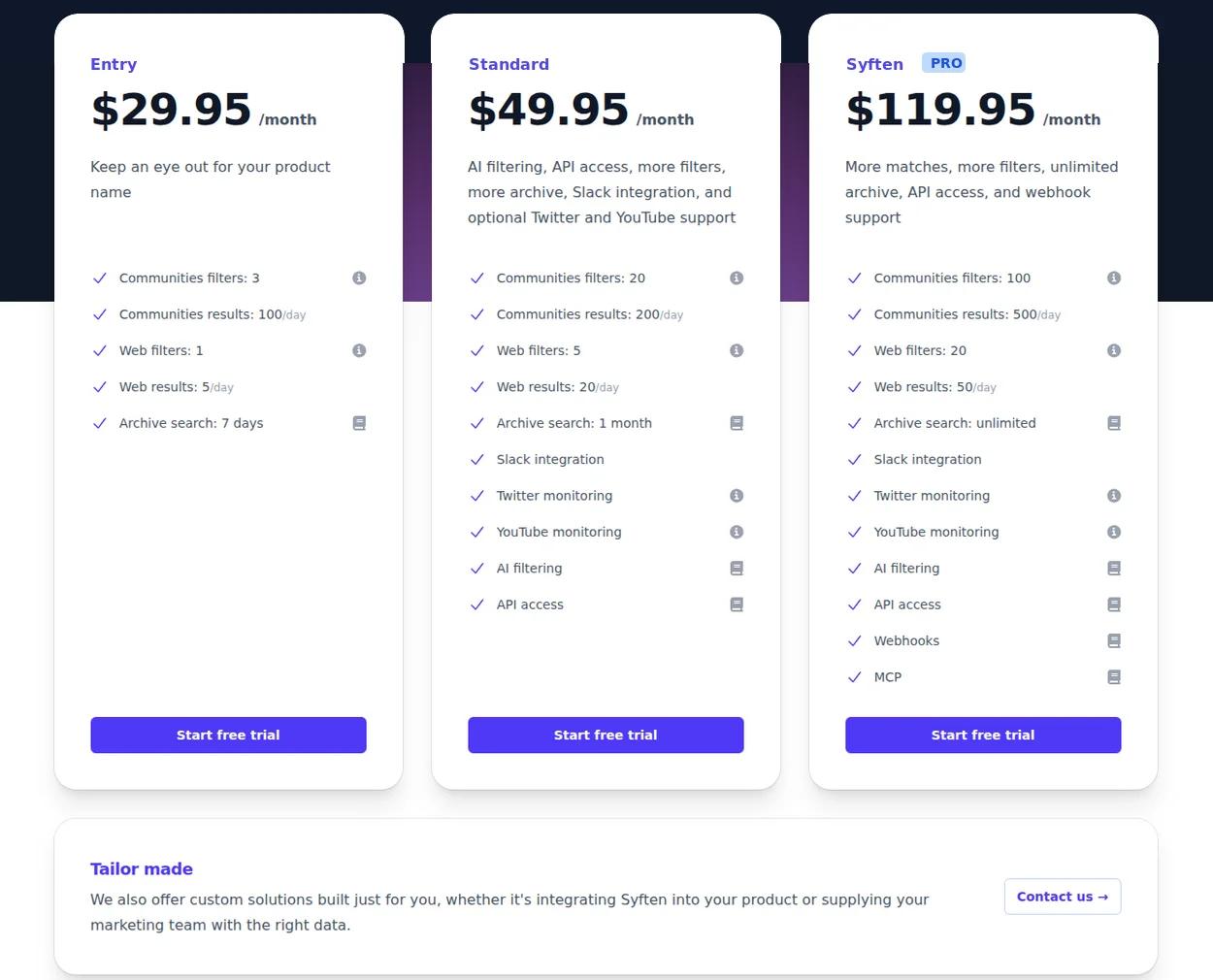
Syften's price reflects the narrower job: useful alerts rather than a full social management or intelligence suite.
Custom pricing is not a flaw when the job is complex. It is often appropriate for global brands, agencies, regulated industries, or teams that need onboarding and governance. It is a warning sign only when the problem is smaller than the purchase motion.
Common buying mistakes
Mistake 1: treating Hootsuite and Brandwatch as interchangeable social tools. They overlap, but the buying center is different. Hootsuite is easiest to defend for social operations. Brandwatch is easiest to defend for intelligence and research.
Mistake 2: comparing vendor feature matrices without checking workflow ownership. A feature only matters if someone owns the work after the feature surfaces data. Who will maintain searches? Who will review dashboards? Who will reply? Who will report?
Mistake 3: buying Enterprise listening for a founder-led alerting workflow. If the whole goal is "tell me when someone asks for a tool like ours," a focused alerting product may create more value than another dashboard.
Mistake 4: underbuying when the brief is truly enterprise. If your team needs governance, approvals, regional workflows, consumer research, visual monitoring, social care, and executive reports, Syften is too narrow. Hootsuite or Brandwatch is the right class of product.
The fastest practical decision
If the comparison still feels close, ignore the feature lists for a moment and look at the work someone must do every week.
| Weekly reality | Best fit | Why |
|---|---|---|
| A social team publishes daily, manages replies, needs approvals, reports on owned channels, and occasionally checks brand mentions. | Hootsuite | The work centers on the social calendar, inbox, analytics, and team workflow. Listening supports execution. |
| An insights or brand team studies competitors, audience segments, sentiment, campaign reception, category trends, and executive reporting. | Brandwatch | The work centers on research, query design, dashboards, and social intelligence. Publishing is optional. |
| A founder or small B2B team wants to know when someone asks for an alternative, complains about a competitor, or mentions a category problem. | Syften | The work centers on the alert and the reply. A dashboard is less important than catching the thread while it can still lead to a useful response. |
This is also the easiest way to avoid overbuying. If nobody will maintain a research dashboard, do not buy a research suite. If nobody will run a social calendar, do not buy a publishing suite. If nobody will reply to alerts, do not buy Syften either.
Hootsuite vs Brandwatch: Which should you choose?
Choose Hootsuite if:
- You need social media publishing, scheduling, inbox management, approvals, analytics, and reports.
- Your social team wants one workspace for owned channels and day-to-day operations.
- Listening should support content planning, engagement, customer care, and social performance.
- You want a self-serve trial before considering Enterprise.
- You are already evaluating Hootsuite Enterprise for Talkwalker-powered listening.
Explore Hootsuite if social operations are the main job
Choose Brandwatch if:
- You need consumer intelligence, audience research, and deeper social listening.
- Your team has analysts or social intelligence owners who will maintain queries and reports.
- You want social management connected to research, listening, benchmarking, and influencer workflows.
- You care more about market insight than basic post scheduling.
- You are comfortable with a demo-led, quote-based buying process.
Explore Brandwatch if social intelligence is the main job
Choose Syften if:
- You want alerts for specific conversations your team can answer quickly.
- The public web, Reddit, Hacker News, GitHub, forums, Slack communities, YouTube, or X/Twitter matter to your market.
- You track competitor alternatives, product complaints, support issues, domains, authors, and buying-intent phrases.
- You want matches delivered to Slack, email, RSS, API, Zapier, or webhooks.
- You would rather pay for precise alerts than a social suite.
Try Syften for community alerts with a 14-day trial
The cleanest decision is not "which product has more features?" It is "which product matches the job we will do every week?"
Pick Hootsuite when the week is mostly publishing, engagement, inbox, analytics, and social operations. Pick Brandwatch when the week is mostly research, listening, dashboards, audience insight, and strategic reporting. Pick Syften when the week is mostly finding specific web mentions and public conversations and acting on them while they are still active.
For adjacent comparisons, see Sprout Social vs Hootsuite, Hootsuite vs Mention, and Talkwalker vs Brandwatch.
Hootsuite vs Brandwatch FAQ
Is Hootsuite better than Brandwatch?
Hootsuite is better when the main job is social media management: publishing, scheduling, inboxes, analytics, approvals, and team workflows. Brandwatch is better when the main job is social intelligence: consumer research, listening, audience analysis, trend discovery, and strategic reporting.
Is Brandwatch better than Hootsuite for social listening?
Usually, yes, if the buyer wants deeper research and social intelligence. Hootsuite's most serious listening capability is Enterprise Listening powered by Talkwalker. Hootsuite can be enough when listening supports a broader social management workflow.
Can you trust sentiment analysis in Hootsuite or Brandwatch?
Sentiment analysis should be treated as a caveated insight, not a clean fact. Brandwatch is stronger for research workflows and Hootsuite is broader for social management, but both categories can produce sentiment charts that look more precise than they are. The buyer should ask whether the tool identifies the sentiment target and whether analysts review ambiguous examples. For the pitfall, read why sentiment analysis is often unreliable.
Does Hootsuite use Talkwalker?
Yes. Hootsuite lists Listening powered by Talkwalker as an Enterprise capability, and its listening page says Hootsuite Listening's engine is powered by Talkwalker's social media monitoring technology.
Does Brandwatch include social media management?
Yes. Brandwatch Social Media Management includes social calendar, engagement, monitoring, benchmarking, dashboards, and related modules such as Publish, Engage, Measure, Benchmark, and Listen.
Which is better for small teams?
Hootsuite is usually the more accessible of the two if a small team needs a social media management suite. If the small team mainly needs timely keyword alerts from the public web, communities, and public conversations, Syften is usually the simpler fit.
What is the best Hootsuite or Brandwatch alternative?
If you need another social media management suite, compare Hootsuite and Brandwatch with Sprout Social, Buffer, Agorapulse, Sendible, or SocialPilot. If you need fast alerts from the public web and communities like Reddit, Hacker News, GitHub, forums, Slack communities, YouTube, and X/Twitter, Syften is the more focused alternative.
If Reddit is the specific channel you care about, compare dedicated options in our guide to the best Reddit monitoring tools before buying a broad listening suite.
This comparison was fact-checked and refreshed in May 2026 against current pricing and product pages. Pricing, feature packaging, and enterprise contract terms can change, so verify current details with each platform before buying.